Hulc
LGL 1 hulc (Human Universal Load Carrier) military. Developed by Berkeley Bionics, now Ekso Bionics, in collaboration with Lockheed Martin. Designed specifically to help soldiers carry heavy loads. The HULC allows f
At a glance
The full review
Boost Your Power with Hulc by Lockheed Martin: The Military of the Future
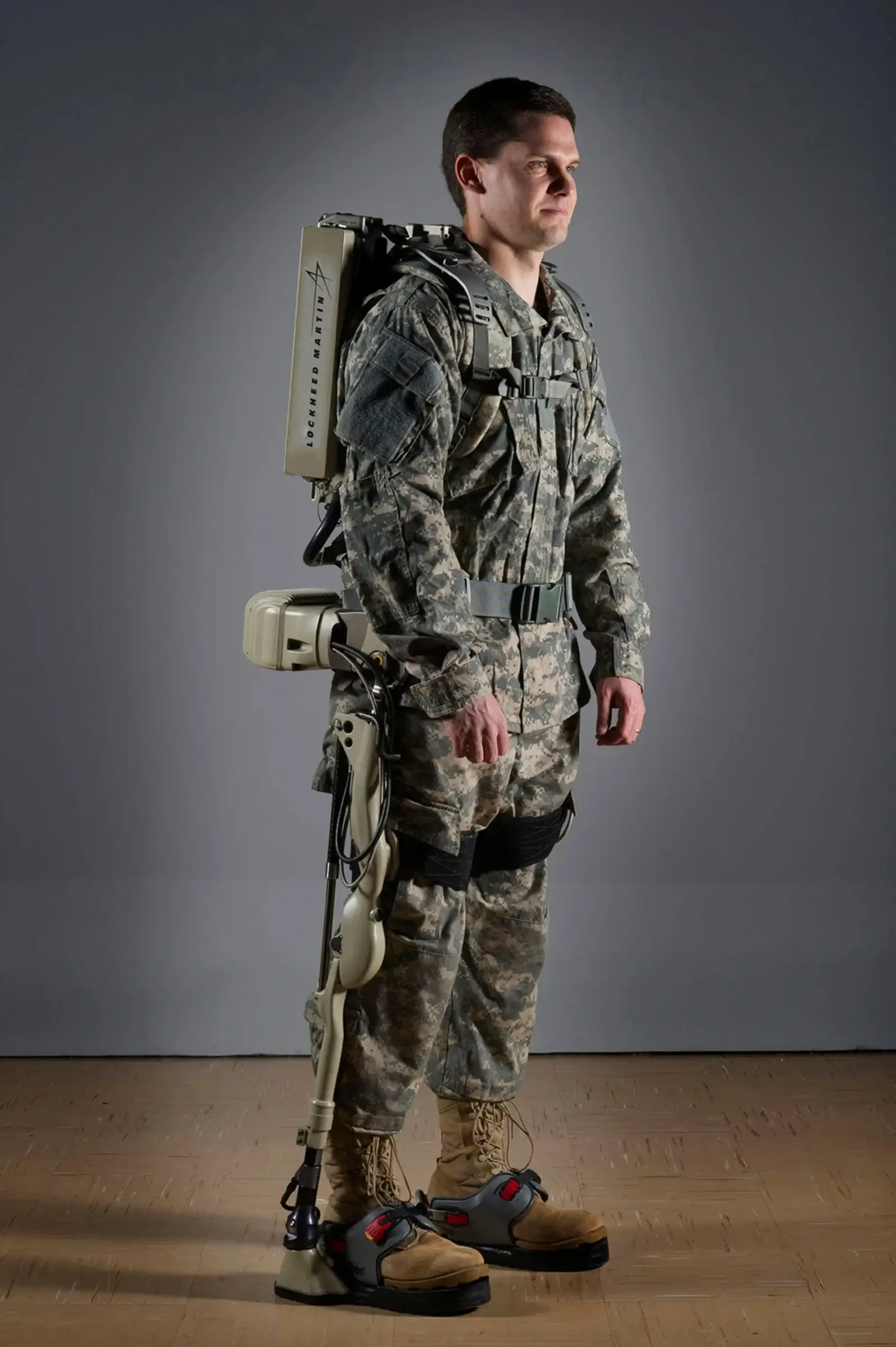
LGL 1 hulc (Human Universal Load Carrier) military. Developed by Berkeley Bionics, now Ekso Bionics, in collaboration with Lockheed Martin. Designed specifically to help soldiers carry heavy loads. The HULC allows for the carrying of loads up to 91 kg. As a result, the risk of musculoskeletal injuries is significantly reduced, and the performance of military personnel on the ground has improved. Although this is a military device, it would be worthwhile to take a closer look at its features. And to find out what really lies behind the Lockheed Martin HULC.
Features of the Lockheed Martin Hulc
Among the series, the Lockheed Martin Hulc stands out with a payload capacity of 91 kg and an all-terrain design. It was developed in 2008 by Berkeley Bionics. Lockheed Martin eventually obtained a license in 2009, before continuing its development and deployment within the U.S. Army. The third-generation features an anthropomorphic hydraulic drive system and a titanium frame. It operates autonomously. The LGL 6 HULC allows soldiers to crouch, crawl, and raise their upper bodies thanks to its flexibility. It weighs 24 kg without the battery and is fully adjustable for soldiers ranging from 1.63 m to 1.88 m in height. Additionally, the HULC is controlled by a microcomputer integrated into the system to detect the user’s needs and adapt to the situation.Furthermore, the HULC by Lockheed Martin has a range of 20 km when the soldier is moving on flat terrain at a speed of 4 km/h. The carried loads can be shifted forward or backward, depending on the soldier’s needs. In terms of travel, the maximum speed is 11 km/h for long-distance travel and 16 km/h for peak travel.
Meanwhile, on November 29, 2018, Lockheed Martin announced that it had been awarded a $6.9 million contract from the U.S. Army Research Center to develop and test “ONYX.” This is a collaborative project with the Canadian company B-TEMIA.
Similarly, TEONYX is a motorized device for the lower limbs, equipped with artificial intelligence (AI). Its purpose is to enhance human strength and endurance.
Lockheed Martin Hulc Test
The advantage of the Hulc exoskeleton is that it transfers the weight of heavy loads to the ground via titanium feet powered by a battery located at the base of the body. The system is equipped with various accessories. These include protective armor, heating and cooling systems, and sensors needed for the mission. The first tests of the HULC took place at the U.S. Army Research Center in Natick, Massachusetts. The committee assessed how soldiers could adapt to using the GL-11 HULC and measured the energy expended by soldiers with and without the device. Field tests were conducted directly at the research center. The tests evaluated the usability of the HULC in combat conditions. The results showed that Lockheed Martin’s HULC allowed soldiers to move with heavy loads of up to 91 kg. This reduces musculoskeletal injuries and fatigue. Consequently, endurance is improved, which has a positive impact on troops during times of conflict. In summary,the HULC is one of the most well-known military devices in the field. Its performance has been repeatedly tested in the field and remains relevant today. It sends a strong signal about the future of military strength and innovation.
Want to learn more? Check out our.